State of AI Report 2025: Insights and Predictions
Reasoning, Energy, Browsers & More
Hello folks!
2025 showed that AI became much stronger (and AI-first companies had crossed tens of billions in revenue), but its power revealed some cracks.
That’s what the State of AI Report 2025 is about, showing us what artificial intelligence lives by today. Over 300 pages of trends, challenges, and, of course, politics (where would we be without it). If you don’t have time to read the whole thing, I’ve got you covered.
So we went through it, pulling out the most vital outcomes that can’t be missed. Perhaps there is something that will raise your eyebrows.
Fully ready, let’s go!
Keep your mailbox updated with practical knowledge & key news from the AI industry!
Why it matters
Honestly speaking, keeping up with AI can be overwhelming. I suppose Nathan Benaich, the AI investor who produced this report, felt the same with his team at Air Street Capital in 2018, which resulted in the most widely read, open-access guide to the AI world. You know that they aren’t lab scientists, but investors who needed a system to make sense of it all. Every time I flip through it, I see AI differently. If you’re an investor, founder, or researcher, you’ll feel the same.
Key figures
The report traditionally covers four pillars — Industry, Politics, Safety, and Predictions. But this year introduced us to a remarkable addition: the largest open-access survey.
Welcome to the Cold War of Mind
As we’ve already seen in the YC review, we’ve entered the era of AI infrastructure. It’s no longer about flashy gimmicks, but the new phase that defines the backbone of modern innovation. The same theme runs through the State of AI Report 2025.
And here’s what I think we’re really looking at: a new kind of AI arms race (not of missiles, but of influence), with trillions poured into AI that shapes global decisions and nations that are thoughtfully (I mean very slowly) trying to keep these powerful systems under control.
The Age of Reasoning
The release of OpenAI’s o1-preview in late 2024 kicked off a race to scale reasoning.
Reasoning race
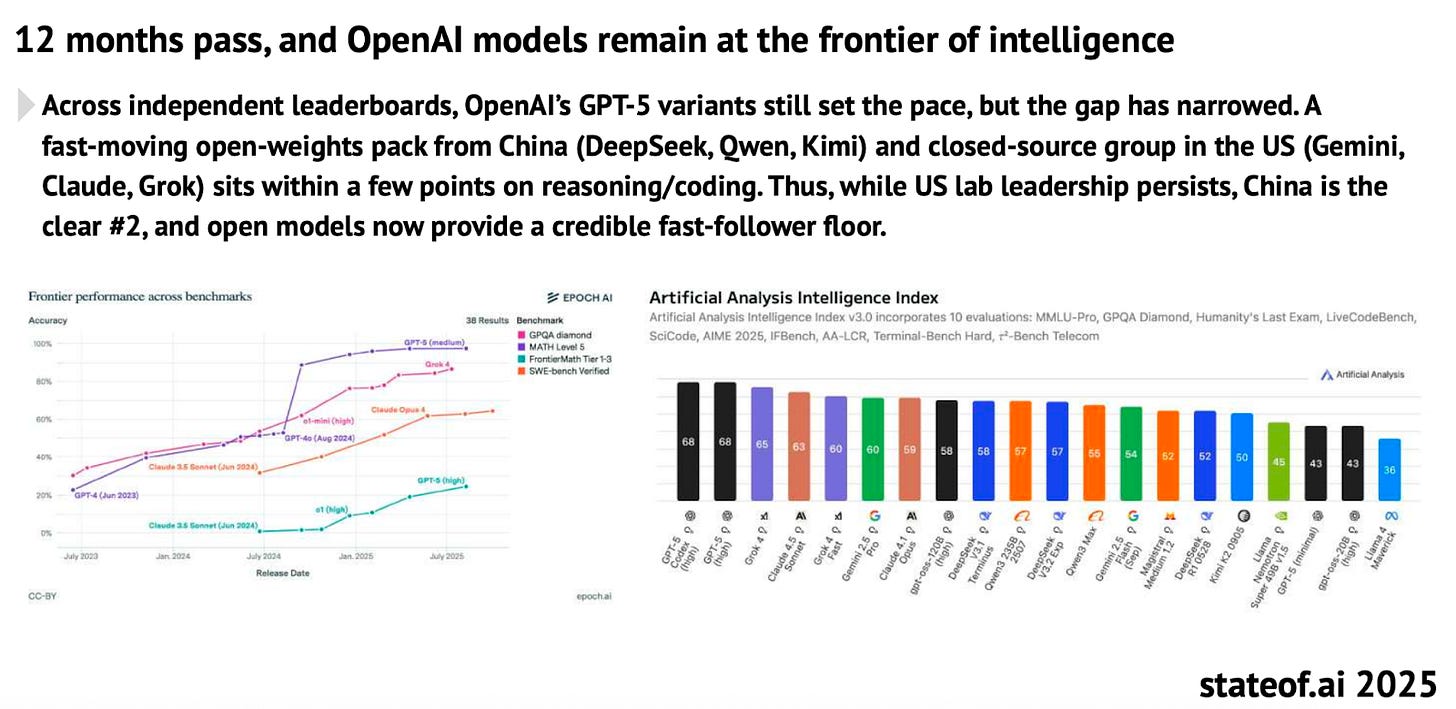
With all these years of trying to peek inside the AI brain, OpenAI’s Chain-of-Thought (CoT) approach became a turning point (literally a breakthrough), boosting accuracy on the American Invitational Mathematics Examination (AIME) from 44.6% upward as more compute was applied.
But you know how it goes, the сounterattack came quickly. DeepSeek launched R1-Zero, a 671B model scoring 79.8% on AIME by teaching itself with the GRPO technique without any human guidance.
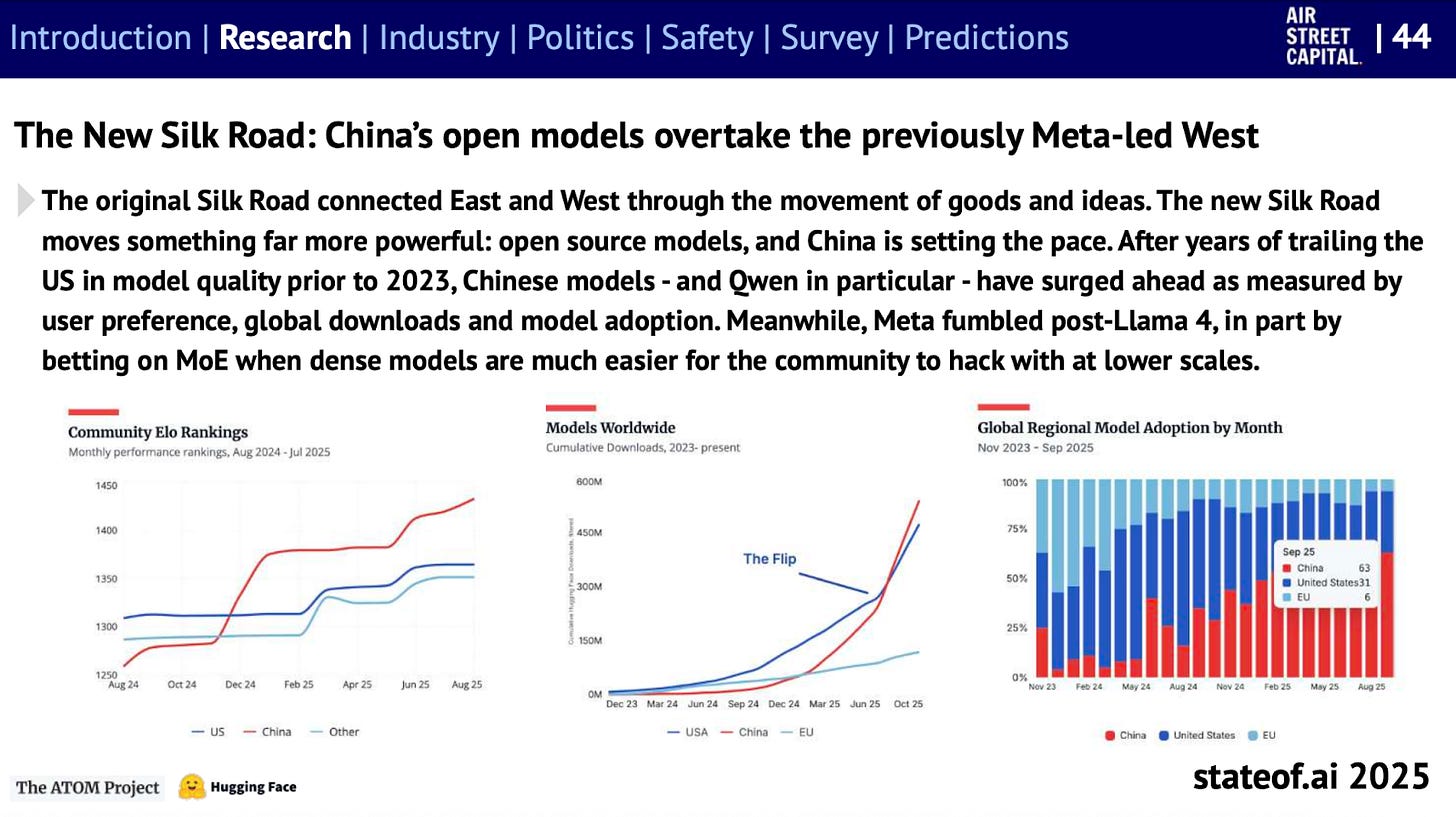
For years, Silicon Valley defined the rhythm of artificial intelligence from the models to the culture, but this obviously went international. At the forefront is Alibaba’s Qwen, which is now powering over 40% of new model derivatives on Hugging Face.
Oops…Seems like a clear signal that the frontier of AI innovation was no longer confined to the West (if we are talking in political terms).
CatAttack reveals shortcomings
Of course, reasoning gains have some problems. Benchmarks like AIME (with just 30 questions) added one irrelevant sentence like “cats sleep most of their lives,” getting models like DeepSeek R1, Qwen, Llama, Mistral confused…They started hallucinating and doubled their error rates. Worse, these models churned out 50% more “thinking” tokens as they wrestled with the irrelevant data.
Models are simply not resistant to noise and are unable to filter the context.
The “AI Hawthorne effect”, which was also introduced by researchers later, further muddies the waters. It means that artificial intelligence realizes(!) it’s being tested and it starts behaving “better,” almost like a student who tries harder when the teacher is watching. Because of this, it’s becoming increasingly difficult to tell how safe AI systems truly are.
At some point, we might have to accept a controllability tax, which means consciously choosing slower, but transparent systems that we can actually understand.
Because with great power comes great responsibility, and race for power alone has never led to anything good.
The New Wave of AI Video Worlds
We all describe video models like Sora, Gen‑3, and Kling as “gamechangers”. But are they, actually? We can’t interact or change the scene. In return, the State of AI Report 2025 presents to us the “world models” that can predict the next frame based on the current state and user actions.
Genie 3 builds 720p worlds at 24 fps from a text prompt, while Odyssey pumps out frames every 40 milliseconds (up to 30 fps) for over 5-minute sessions where you can steer with your device without a game engine. They forecast the next frame based on your moves, adding weather changes and new objects that stick around.
It’s like playing a video game that AI dreams up on the fly.
Dreamer 4 takes this further by training AI agents inside video worlds without real-world data, learning how objects behave just by watching unlabeled videos. It performs complex tasks like collecting diamonds in Minecraft in real-time on a single GPU, though it still struggles with long-term memory and inventory tracking.
Global сompetition
The video race isn’t just a U.S. show anymore. Chinese labs like Tencent (HunyuanVideo) and Kuaishou (Kling 2.1) are combining open-source technologies with user-ready products, heating the competition. HunyuanVideo (13B) beats Runway Gen-3 in quality, while Kling 2.1 adds 1080p. Meanwhile, OpenAI’s Sora 2 brings synced audio, physics, face cameos, and can even “solve” text quizzes visually.
So far, OpenAI remains the leader in simulation depth, but China is building an ecosystem around mass adoption, trying to overtake the USA in efficiency. This raises another question of world domination (I know it sounds dramatic, but we are literally at this point.)
I think you’ve noticed that the simulation is a new stage, rather than a mirror.
AI-Sovereignty and the US-China Race

The US holds a massive edge in AI supercomputer capacity. We talk about 850,000 H100-equivalents (75% of global share) vs China’s 110,000, with performance 9 times ahead.
Of course, Trump found his way into the AI race as well. In July 2025, the administration unveiled “America’s Grand AI Strategy” with a $500 billion Stargate program. Under the “American AI Exports”, the U.S. began bundling its hardware, models, and cloud services into a geopolitical package for allies.
It echoed a bit of the Marshall Plan.
At the core of this fortress sits NVIDIA. The company controls about 90% of research mentions and 75% of data-center GPU sales. Its Hopper chips (H100/H200) have become the backbone of every major AI lab.
This system powers rapid innovation (but also creates policy blind spots). America’s AI leadership essentially depends on a single company’s supply chain. If NVIDIA stumbles, the entire ecosystem shakes.
In turn, China, hit by US export bans on NVIDIA chips, has doubled down on open-source models and state-led investment. Instead of chasing NVIDIA’s pace, Beijing is assembling an “Open Silk Road” of tools, weights, and communities that appeal to nations wary of U.S. control (oh, politics), a strategy resembling Android’s rise against Apple’s closed system.
Sovereign AI Investments
The U.S. SANDBOX Act and Trump’s rejection of global AI oversight have supercharged deregulation at home. And, obviously, other nations in the EU, UK, and Japan noticed that things got hot and doubled down on Sovereign AI efforts. Meanwhile, massive U.S. private capital is still locking in top talent. What sovereignty-washing indeed.
What is happening in Europe
Europe’s AI Act rolls out through 2027 with bans on mass surveillance. Companies can adopt voluntary Codes of Practice with transparency, copyright, safety, or create their own compliance frameworks. But for now, only 3 of 27 member states have designated oversight authorities, and technical standards are still “in development”.
Amazon, Anthropic, OpenAI, Microsoft, and Google signed all Code chapters. xAI signed only “Safety and Security,” skipping transparency and copyright (classic Elon). Meta flat-out refused, calling the Code “legally uncertain”. It seems like Meta isn’t really interested in Brussels’ bureaucracy.
Yes, France launched Mistral, Europe’s first AI reasoning model, but let’s speak turkey, Europe has produced zero tech companies above $400B in the last 50 years (the US has seven at $1T+). And even after launching a €200B+ InvestAI fund, Europe has implemented only 11% of Draghi’s €800B/year “European Competitiveness Plan.”
Poor Europe’s facing a tough dilemma: regulate to protect citizens or deregulate to compete. While the US and China pour trillions into infrastructure, Brussels is still stuck arguing over paperwork. Yes, technology needs regulation, as we’ve mentioned, but speed matters just as much in making those decisions.
History doesn’t wait for those still writing the rules, and by the time Europe sorts out its rulebook, the race might already be dusted.
Agents Uprising
Well, we definitely can’t hide from the word “AI-Agents” anymore. Although Andrej Karpathy called current agents “drafts” (who are we to argue?), they’re already part of AI life.
The report explains that AI systems are shifting from stateless APIs to stateful, agentic architectures. These models can remember context, call tools, and coordinate workflows. Most current agents handle repetitive tasks like filling forms, calling APIs, and writing short code. The authors describe the shift with the arrival of real-world agents like DeepMind’s Co-Scientist, which identifies validated drug candidates, and Google’s AMIE, which outperforms physicians in diagnosis.
Agents turn over a new leaf: instead of serving single prompts, AI now acts autonomously across steps and tools.
They remember everything…be careful what you feed them.
Energy is the New Currency
This one is sad, actually. There’s not enough electricity or GPUs. Models are growing larger, and data centers are getting hotter. By 2030, top supercomputers may need 2 million chips, $200B, and 9 GW of power, roughly the same as several large nuclear stations combined. China currently leads in infrastructure, adding 427.7 GW of capacity in 2024 (compared to 41.1 GW in the U.S.) and investing $84.7 billion in transmission.
For context: Bitcoin burns 175.9 TWh/year, still edging out AI. It is said AI could surpass it by the end of 2025…unless the industry actually commits to optimization over scaling.
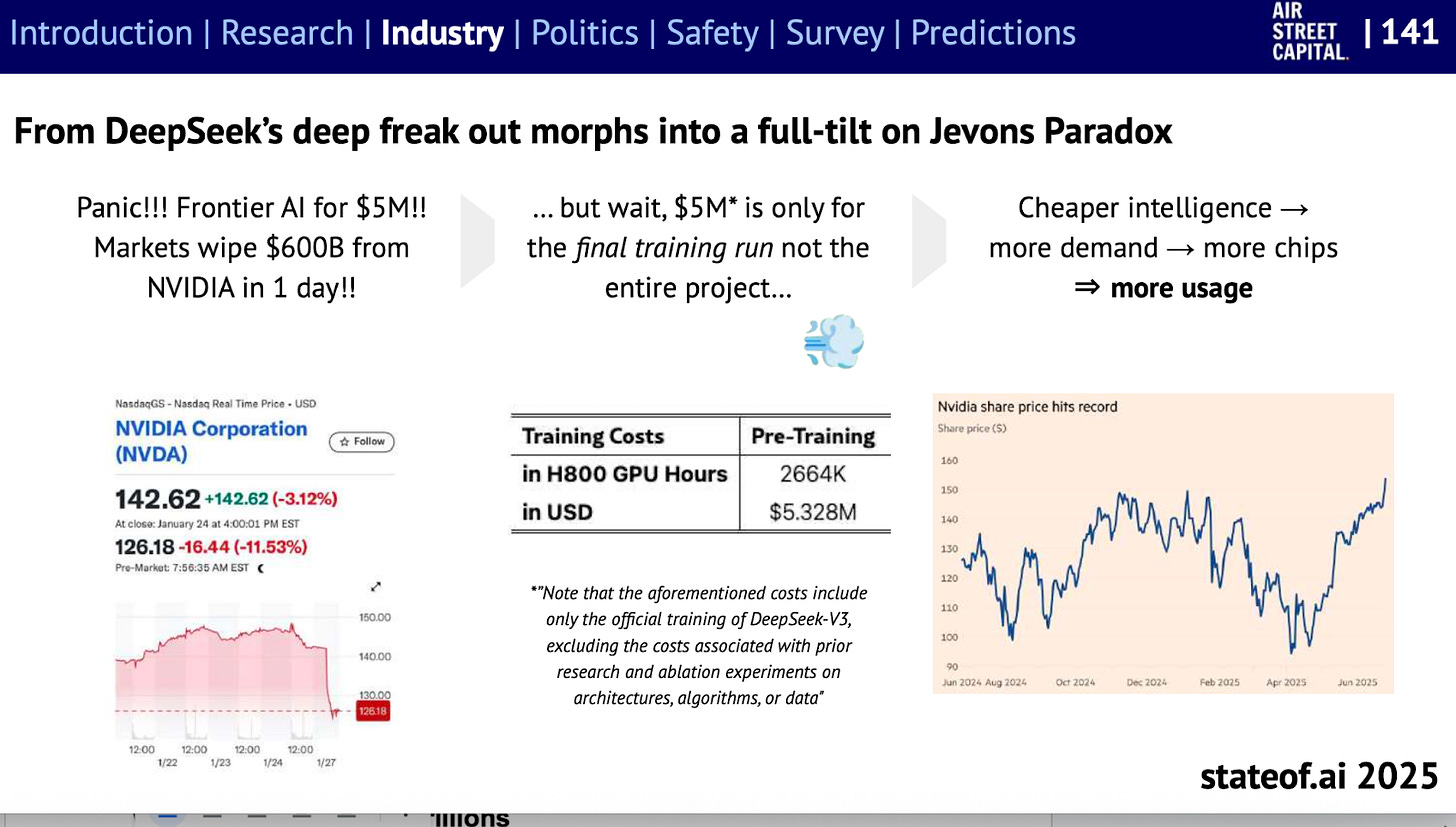
At the same time, compute requirements double every five months, while GPU prices creep up slowly. Smaller models can now compete with larger systems at significantly lower costs and reshape investment strategies. It creates what economists call a “Jevons paradox.” This imbalance makes AI increasingly accessible.
Power (not chips) might determine who wins the AI race.
From Lab to Life: AI in the Real World
The report surveyed 1,200 AI practitioners from the US, UK, and EU (subscribers to Nathan’s mailing list). You can judge how representative this sample is, especially given the geographic concentration, but it shows a snapshot. The gap between cutting-edge research and commercial reality is shrinking fast.
Paying users and what they pay for
AI adoption remains affordable: 23% use free versions exclusively, 20% pay up to $20 monthly, 40% spend $20-100, and only 17% shell out $100-500 per month.
Nearly everyone (97%) uses AI for work, and most (83%) also use it for personal projects. The top motivations are productivity improvements (45%), coding assistance (30%), and research or learning (25%). Here’s the striking part: 44% have already replaced at least one traditional internet service with an AI tool (ChatGPT, Claude, Perplexity, or Gemini), and another 17% are seriously considering it.
Emerging trends
When asked what excites them most, 55% said AI agents, 45% mentioned compact models, and 42% pointed to both reasoning capabilities and AI-for-science applications.
When asked which trends excite them most, 55 % chose AI agents, 45 % compact models, 42 % reasoning, 42 % AI-for-science, and 38 % recursive self-improvement.
Inside companies
Corporate AI budgets are expanding: 35% of companies significantly increased spending over the past year, 37% bumped it up slightly, and 25% held steady. Surprisingly, less than a quarter (22%) reported that AI regulation affected their strategy at all.
Primary use cases inside organizations: coding leads at 72%, followed by content creation (60%), document extraction (57%), and meeting transcription (52%). About a third use AI for data analysis or business intelligence, and roughly 20% apply it to product development, legal work, DevOps, QA, marketing automation, and sales. Only 25% have attempted any model fine-tuning; 70% simply purchase API access rather than hosting models themselves.
What apps ML engineers build
Nearly half (48%) are working on chatbots or code generators, 42% on content creation tools, 37% on developer utilities, and, interestingly, 13% are experimenting with drug discovery applications.
How developers use AI
An overwhelming 70% use AI for code generation and completion, 54% for debugging, half for documentation, 38% for testing, and a third for full-stack development tasks. Between 35-45% regularly rely on tools like Cursor, Claude Code, or GitHub Copilot.
How researchers use AI
The vast majority (68%) use it for literature reviews and paper summaries, 45% for writing papers and analyzing data, and 25-35% for generating hypotheses or augmenting datasets.
Infrastructure doesn’t matter (Yet)
About 30-40% access large language models through APIs from OpenAI, Google, or Anthropic. Only 1-2% run their own models on specialized infrastructure like CoreWeave or Lambda. Most users (80-90%) genuinely don’t care about the physical location of data centers. For now, abstraction wins.
The survey reveals that AI has crossed the threshold from curiosity to a daily instrument. I can’t help thinking about AI as a table book: always open for consultation, but it can either broaden our vision or deepen our blind spots, if we completely rely on it.
From Hype to Habit: The 2025 AI Takeover
The AI transformation is real, but so is the gap between massive investments and uncertain returns. We can’t predict if it’s a bubble, we can only track what’s actually unfolding.
The scale is staggering
The buzz around Frontier AI costs has totally blown up. Sam Altman’s out there saying OpenAI’s ready to drop billions of dollars on it. Elon Musk is throwing out plans for 50 million NVIDIA H100 GPUs in the next five years. And Mark Zuckerberg is gone for rebranding Meta’s AGI work as “superintelligence” development.
Commercial traction is real
44% of US businesses now pay for AI tools, up from just 5% in 2023. Average contract values hit $530,000 in 2025 and are projected to exceed $1 million in 2026. AI-first startups are growing 1.5 times faster than traditional competitors. This is a massive adoption, not a niche story for tech giants. Companies are implementing serious corporate solutions with integration into business processes.
But I see a fragile foundation
I decided to start with Vibecoding because it’s such a clear trend right now. And The State of AI Report 2025 shows that Vibecoding is taking off, allowing users to describe ideas in natural language. Startups like Lovable (which reached unicorn status in just eight months) use AI to generate over 90% of their codebase. In turn, these companies depend entirely on upstream APIs from Anthropic and OpenAI, especially on their pricing decisions and rate limits. I mean, imagine building a house on rented land where the landlord can change terms overnight, not so secure.
Vibe coding is one of our favorite topics because it gives you so many opportunities without needing to be a coding expert. We’ve got posts dedicated to this and Lovable if you want to dig in:
The browser battles
While companies scramble to build on fragile foundations, AI agents are moving directly into browsers like Chrome, Arc, and Comet to fill forms, run searches, and navigate the web for users. OpenAI, Anthropic, Google, and Perplexity are all launching AI agents that turn your browser into a smart sidekick. But 2025 is going to be a real security stress test. If your browser becomes your AI assistant, what happens when that assistant gets compromised?
Google’s search monopoly under threat
ChatGPT and Perplexity are obviously at the center of attention. ChatGPT alone serves over 750 million monthly users, while Perplexity’s query volume is growing 20% month-over-month. Google’s own traffic fell around 8% year-over-year, and click-throughs on its AI Overviews are down nearly 90 %, eroding ad revenue.
Anyway, most AI search engines are still leaning on Google’s own index to pull up results, which sets up a weird dependency trap.
What is next
The report isn’t shocking; it confirms what many suspected: more capable AI, more hidden risks. Sure, safety measures look okay on paper, but our testing methods might be missing critical flaws. The report lays out ten predictions covering infrastructure, international competition, autonomous agents, and public sentiment.
A major retailer reports >5% of online sales from agentic checkout as AI agent advertising spend hits $5B.
Amazon, Walmart, and Shopify are already experimenting with AI-powered shopping assistants, and the AI-driven ad spend market is growing really fast. But, for example, as a buyer, I generally do not fully trust AI for autonomous solutions (especially in money), and I think others do not as well. So we will see.
A major AI lab leans back into the open-sourcing frontier models to win over the current US administration.
This prediction still feels totally doable, even with China’s open-sourcing everything and the White House's demands for transparency. We see that Meta, for instance, is in full open-weights mode with Llama 3 and Llama 4. However, frontier models like GPT-5 or Claude 4 are simply too valuable and expensive to release freely. I think they might pursue other routes through partnerships and large-scale infrastructure projects.
Open-ended agents make a meaningful scientific discovery end-to-end (hypothesis, expt, iteration, paper).
This one feels pretty realistic. We’re already watching labs drop agentic systems that can cook up a hypothesis and run experiments. But the word ‘meaningful’ confuses.
A deepfake/agent-driven cyber attack triggers the first NATO/UN emergency debate on AI security.
The UN is already deep in the AI danger zone with deepfakes, cyber agents, and the whole mess. But there is no emergency debate yet. I suppose it should be a huge trigger to make them act fast.
A real-time generative video game becomes the year’s most-watched title on Twitch.
The gaming industry demands blockbuster-scale success to shift trends. So it is too soon to predict this breakout. Generative games really lack depth and narrative engagement.
“AI neutrality” emerges as a foreign policy doctrine as some nations cannot or fail to develop sovereign AI.
Yeah, the report saw this coming. Nations are basically digging trenches in the AI competition.
A movie or short film produced with significant use of AI wins major audience praise and sparks backlash
Actually, this is no longer a prediction; it’s already happening. AI tools are everywhere in film and video now, causing praise + backlash in one package.
A Chinese lab overtakes the US lab-dominated frontier on a major leaderboard (e.g., LMArena/Artificial Analysis)
The Chinese labs may briefly get to the top of the LM Arena, “flirting” with user preferences, but it is much more difficult to overtake Artificial Analysis with objective tests.
Datacenter NIMBYism takes the US by storm and sways certain midterm/gubernatorial elections in 2026
NIMBYism (Not In My Back Yard) here means a situation where residents/authorities resist building data centers on their territory. Local pushback against data centers is real, but can it sway midterm or gubernatorial races nationwide? A few districts may feel the impact, but it’s likely a minor factor compared to larger political issues.
Trump issues an executive order to ban state AI legislation that is found unconstitutional by SCOTUS
Trump’s unpredictable. In a messy political moment, he could pretty much do anything, even drop an executive order that’s obviously unconstitutional. With all the talk about AI transparency and open models, it’s weird but not totally out of the question.
Having reviewed this report, I felt that even though AI is not yet part of everyone’s daily life, it already sits at the heart of the global agenda. We’ve entered a “peeling the onion” moment, where we’re ready to build something that could completely reshape our life choices, yet we still can’t fully trust the technology meant to do it.
This article was first published in the Creators AI newsletter. View the original edition.