Using ChatGPT to Analyze Market Stocks
+ Useful Prompts for analyzing your financial decisions.
Hi!
What do you think about using AI to analyze finance and stocks? My experience is that people around think it's a rather ambiguous venture. And they can be understood; nobody wants to lose their money because of another LLM hallucination.
At the same time, there are many solutions already available on the market that are used by professionals, such as BloombergGPT and FinGPT. However, these models are either expensive or require highly specialized knowledge. So, let's democratize this a bit and see how we can use ChatGPT to analyze finance and stocks.
Skepticism | “GPT Won’t Work for Analyzing Finances”
Whenever we discuss the use of AI in traditional industries (and areas where LLMs have not been used before), the first thing I try to do is look at the situation through the eyes of a skeptic. And today's one is no exception. Besides, finance is such a sensitive topic, perhaps one of the most important, that we have to discuss the prospects and risks of using neural networks here.
However, since I'm not sure I'm qualified to discuss this issue from a professional's perspective, I propose paying attention to real experts. To make it more honest, let's briefly review two cases where the financial industry meets AI.
Keep your mailbox updated with practical knowledge & key news from the AI industry!
Case 1 | Bloomberg & Its GPT

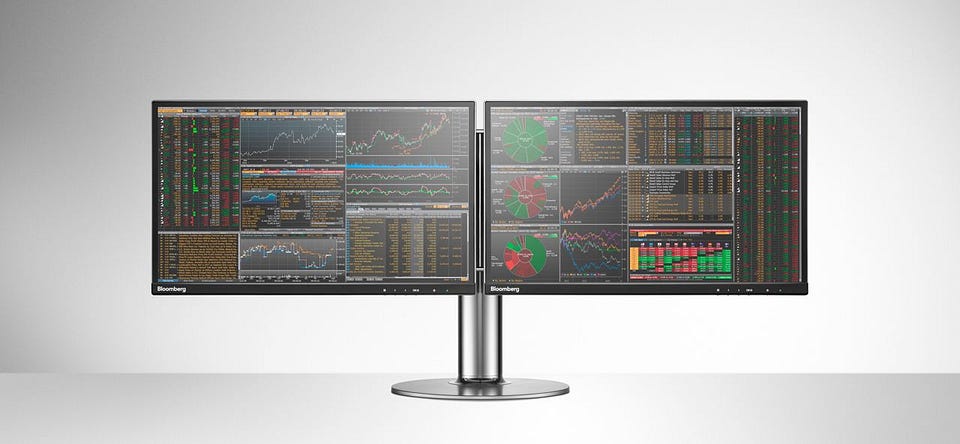
I am not sure that Bloomberg needs an introduction. Still, I will nevertheless clarify that it is a news agency and one of the two leading American data providers for professional financial market participants. Bloomberg's key product is Terminal, through which you can access current prices on almost all world exchanges and many over-the-counter markets. So, as of this year, Terminal is partially AI-powered.
Terminal users received summaries and analyses of company performance prepared by LLM earlier this year. These summaries help analysts save time digesting earnings data and transcripts by highlighting key points. They are already available for companies in the Russell 1000 and the top 1000 companies in Europe. Bloomberg claims its AI summaries help uncover more profound insights and give clients a competitive advantage.
This platform is built on BloombergGPT, a large language model with 50B parameters, trained on a wide range of financial data. It demonstrates impressive capabilities in a variety of natural language processing tasks in the financial domain:
- Sentiment analysis of financial texts
- Classification of financial news
- Question-answering on financial topics
- Generating Bloomberg Query Language (BQL) from natural language prompts
So yes, the “big guys” also already relying on AI. But the main disadvantage of this model is its cost. Only Terminal users have access to it.
Case 2 | FinGPT by AI4Finance-Foundation

The other case study is FinGPT. It is an open-source financial language model (FinLLM) developed by the AI4Finance-Foundation. Based on GPT-4 architecture, it is designed for financial applications, with a focus on providing useful natural language processing tools for the industry. A notable feature is its ability to gather and process real-time financial data from news, social media, filings, and research sources.
This data-driven approach helps ensure the model remains up-to-date with current financial trends. FinGPT also uses efficient methods such as reinforcement learning and fine-tuning techniques like LoRA and QLoRA to keep updating the model at a relatively low cost—estimated at $262 for fine-tuning. The model has four layers: data source, data curation, the language model, and application, making it adaptable for various financial uses.
I would call FinGPT the best option for using AI in finance. However, the threshold of entry here is really high - you need to have a broad knowledge of working with large language models and their customization.
Sharing is caring! Refer someone who started a learning Journey in AI!
In fact, these quite different cases summarize one important point. Listed tools above are strictly tied to their high-value customers and make their money not from marketing but from contracts with investors and enterprises.
So their decisions to use AI are not a pretty marketing story where the top executives shout, “Yes, we love ChatGPT!” but a cold calculation designed for long-term benefits. So, if professionals are already using advanced models extensively in finance, why shouldn't we try it too? Let's see how it can be done using only ChatGPT.
Using ChatGPT To Work with Finances & Stocks
To begin with, it is important to note: although GPT works well with numbers and quickly structures the available data, AI is still prone to hallucinations. Until this problem is resolved, it is important to double-check its results and not take the answers as truth and a call to action. Use it as a helpful source of additional information and a platform for summarizing ideas and explaining concepts.
Here are some of the prompts I recommend for finance and stocks:
Gaining Business Insights
Explain to me [Company’s name] exact business modelWhat are [Company’s name] economic moats?How easy is it for [Company’s name] to scale?With these prompts, you've got a good sammari about the right company. If it's a popular brand like Amazon, Apple or Tesla, the information will be very detailed. Just what you need to make the right decision.
Fundamental Analysis
"Summarize [Company’s name] latest income statement and explain its profitability.""What does [Company’s name] balance sheet reveal about its debt-to-equity ratio?""What is the P/E ratio of [Company’s name], and how does it compare to industry averages?""Can you explain [Company’s name] ROE (Return on Equity) and what it says about management efficiency?"The more precise your prompt, the better the results. Instead of asking a broad question like "How is Company X performing?" try to break it down into smaller, specific queries. Specificity helps ChatGPT to focus on the relevant data and provide clearer, more actionable insights.
Technical Analysis
"Can you calculate the 50-day and 200-day moving averages for [Company’s name] stock and explain their significance?""Is [Company’s name] stock price currently above or below its 100-day moving average, and what does that indicate?""Identify the recent support and resistance levels for [Company’s name] stock.""How does [Company’s name] stock react to its current resistance level?"When analyzing stocks, it’s beneficial to ask about both fundamental (financial health) and technical (price movement) aspects. A combined approach gives you a more holistic view of the stock’s potential, balancing company performance with market behavior.
Sentiment Analysis
"Summarize recent market sentiment around [Company’s name] based on social media and news reports.”"Is the overall sentiment for [Company’s name] stock positive or negative following the latest earnings report?”"What is the market's reaction to the recent merger announcement of [Company’s name]?”"Analyze how the latest regulatory news affects investor sentiment for [Company’s name].”Here I recommend providing the latest news summaries to make sure the chatbot is talking about what it knows and not making up facts.
Comparative Stock Analysis
"Compare the financial performance of [Company’s name] and [Company’s name] in the same industry.""Which company has a better P/E ratio and growth prospects between [Company’s name] and [Company’s name]?""How does [Company’s name] stock performance compare to its top three competitors over the last year?""What are the key differences in revenue and profitability between [Company’s name] and [Company’s name]?"Don’t just analyze one stock—ask ChatGPT to compare multiple stocks in the same industry or market. Comparative analysis helps to identify better investment opportunities and evaluate a stock’s relative performance against its peers.
Final Thoughts
While researching the topic of using AI to analyze financials and stocks and testing various prompts, I concluded that ChatGPT is good at evaluating the provided financial data, summarizing market reports, and explaining relevant concepts such as EPS, debt-to-equity ratio or net income. If you don't have a deep knowledge in this field but want to get a basic understanding of how markets work, then you should try the listed prompts (and maybe even create new ones based on them).
As for more experienced investors, they can use GPT data to predict future performance and determine whether a stock is in line with their investment strategy. AI is good at analyzing historical data and highlighting patterns in revenues, profits or expenses that may signal a company's growth potential or areas of concern.
Share this edition with your friends!
This article was first published in the Creators AI newsletter. View the original edition.