How Influencers Turning AI Chatbots into Millions
They made AI more personal, and it paid off

Hello friends!
Creators are making the most of AI. Crucially, 87% of them now integrate AI into their workflows, with 91% having used it for content production and 92% of marketers commissioning AI-assisted creator work.
This transformation isn’t just experimental; it generates sustainable revenue. Creators using AI tools report a 60% engagement boost, while AI-enhanced content formats generate ROI multiples of 520% to 890%!
Amid these numbers, a new trend is taking off: AI-created personalities that are rapidly multiplying online. These digital clones, powered by AI, entertain, educate, and support.
The global virtual influencer market alone was valued at $6.06 billion in 2024 and is expected to reach $45.88 billion by 2030, growing at a staggering 40.8% CAGR between 2025 and 2030.
For influencers, these so-called synthetic personalities aren’t just a support tool or a low point in customer service; they are the business itself.
Today, let’s break down how this works and how this shift could be useful for your own business.
Keep your mailbox updated with practical knowledge & key news from the AI industry!
The Rise Of AI Influencers

From the film Her to a real collection of people falling for AI, confessing their secrets to ChatGPT, and forming emotional bonds with digital entities, all of these point to one thing: the growth of AI platforms is deeply emotion-driven.
People show a high willingness to pay for interaction, not just passive consumption. They turn to AI to solve various problems and treat chatbots as personal assistants, confidants, and sometimes even therapists.
Most of us, at some point, used it in a more personal way at least once
And now, stars are cashing in. In an environment like this, monetization improves as engagement goes up and marginal human cost goes down.
As AI personas continue to evolve, creators are actively exploring opportunities with digital twins. Research from Billion Dollar Boy shows that 85% of creators are open to building a digital twin in partnership with a brand for marketing purposes.
Zooming out even further, investment in digital twin technology is accelerating worldwide. Projections suggest it could grow by 60% annually over the next five years, reaching an estimated $73.5 billion by 2027.
It’s becoming the infrastructure for something that has no clear legal or social framework yet, but has enormous potential in the eyes of influencers.
AI Video Breakthroughs and Why Consumers Are Trusting Them
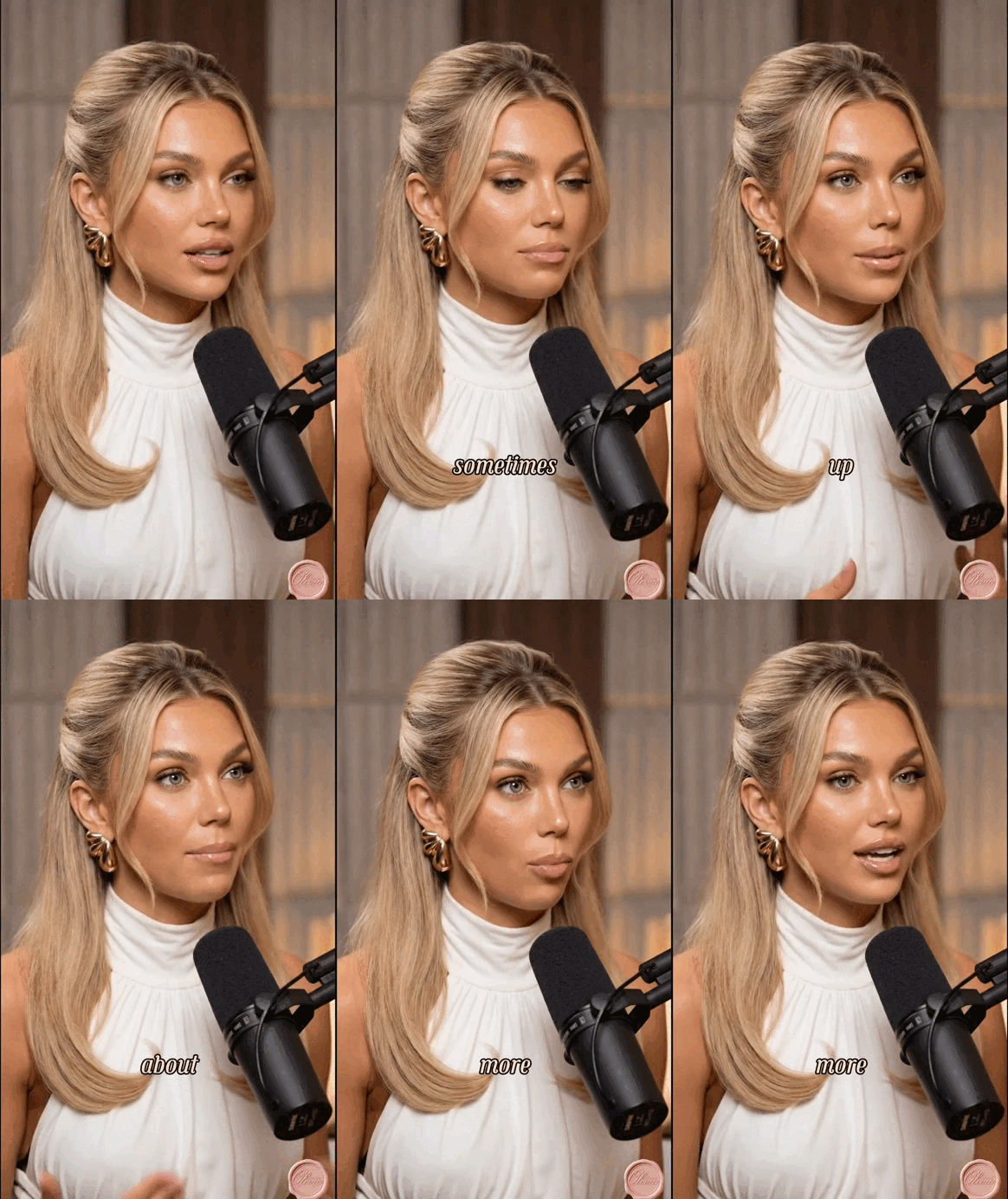
Yes, this is AI. Inst: OliviaBrand
We’ve been following the upscaling in AI in AI video, voice, intonation cloning, and motion capture that now make it possible to create human-like videos without filming every single time, and even across multiple languages.
Brands are using this to create ads and social content faster than ever, while creators can produce more content with far less effort.
New independent research from Billion Dollar Boy shows just how far this shift has gone. The study surveyed 4,000 consumers, 1,000 creators, and 1,000 marketers across the US and the UK, and the results are telling that
- 76% of consumers say they trust virtual influencers when it comes to product recommendations
- 68% say they would rely on them to inform purchasing decisions
In other words, virtual influencers are no longer just a gimmick. They’re building real credibility, growing loyal audiences, driving engagement, and establishing authority in specific categories.
This shift is backed by serious capital. Investment in digital twin technology is expected to grow by around 60% annually over the next five years, reaching an estimated $73.5 billion by 2027.
The Chatbots Are Taking Over: Successful Cases
While we’re still trying to wrap our heads around AI, influencers are already squeezing every last drop out of it. Even though it gets tougher for everyone to control their image and voice.
$99 a Month for an AI Coaching App
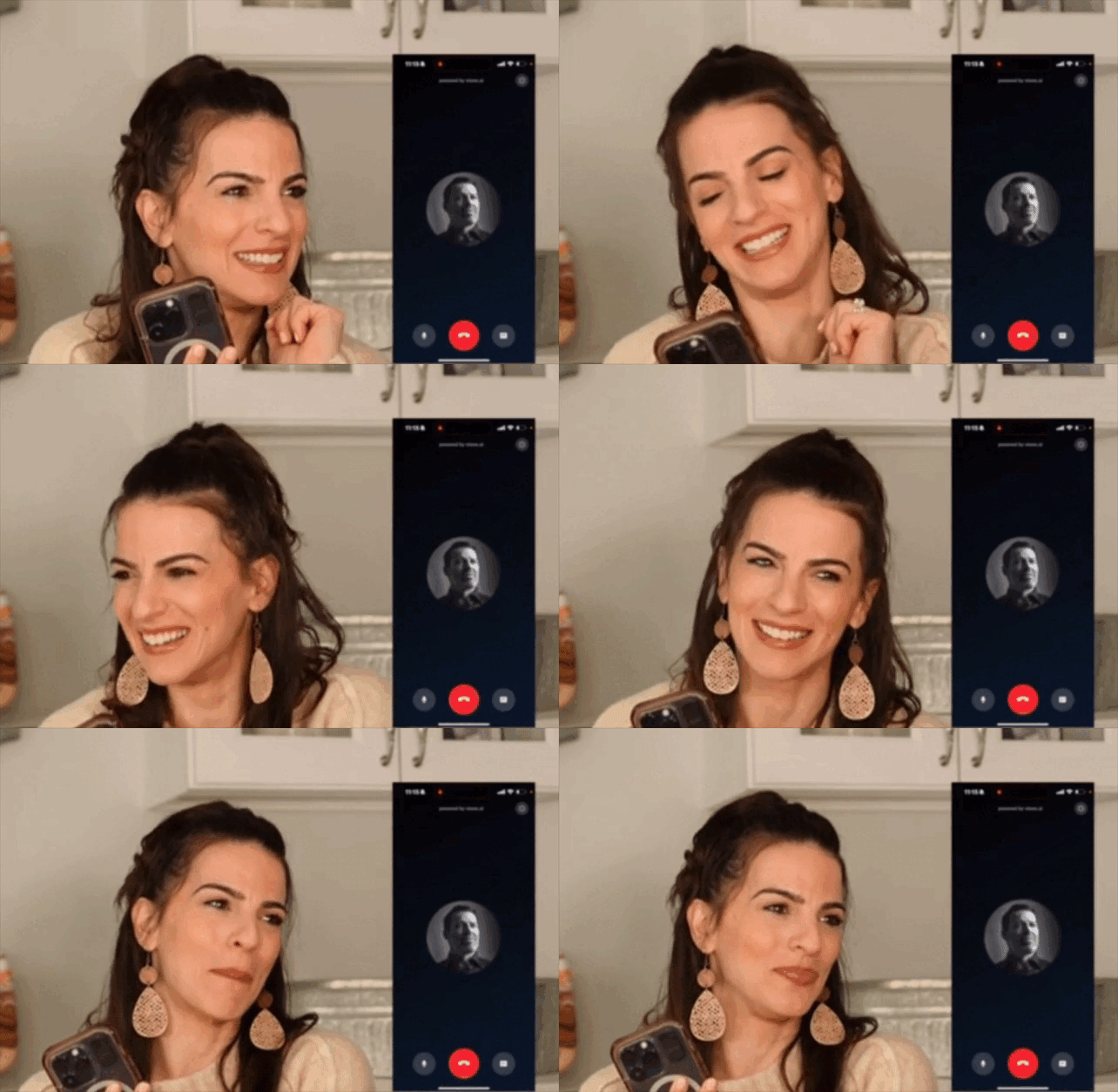
Tony Robbins, a motivational speaker and life coach, has launched his brand-new AI coaching app, which is built from his talks, books, and interviews.
Users interact with a chatbot that replicates Tony's exact voice, energy, and strategies, delivering voice-driven coaching sessions trained on decades of his content.
Honestly, when I learnt about this, my first thought was: I could just dump all his books into NotebookLLM and turn his advice into a podcast FOR FREE.
Anyway, Robbins’s approach is to push the limits of one-on-one coaching, letting him democratize access to his high-level expertise. This way, he is making knowledge accessible and changing the way we communicate, according to his team.
The app gives instant access to Robbins’
- frameworks
- tools
- methods.
It’s all tailored to your personality. On top of that, the AI learns from you, constantly improving to meet your needs.
Obviously, the goal is profit. Look at the sales pitch: it’s essentially selling emotional dependency. I highlighted the “Tony in your pocket” and “I ask questions I wouldn’t say out loud” lines on his website that is clear authority bias in action.
The AI Clone Economy: How Creators Monetize Digital Versions of Themselves
All this comes at $99/month (though Tony generously lets you test-drive it for 14 days at $1, not even free). That’s 4x bigger than ChatGPT Pro, if you’re interested.
We’re talking millions of dollars in annual revenue😮
Using only Tony’s own public pricing as a basis:
Annual subscription: $390/year (≈ $32.50/month effective, 68% off the monthly rate). If he has:
- 10,000 paying annual subscribers → $3.9M/year gross.
- 100,000 paying annual subscribers → $39M/year gross.
- 500,000 paying annual subscribers → $195M/year gross.
These are just examples, but they show how AI twins can become an 8-9 figure ARR product this quickly due to:
- No marginal delivery costs, as adding users doesn't require hiring more staff or increasing production + application support.
- Global distribution (23 languages, 24/7)
How’s this trend shaping up?
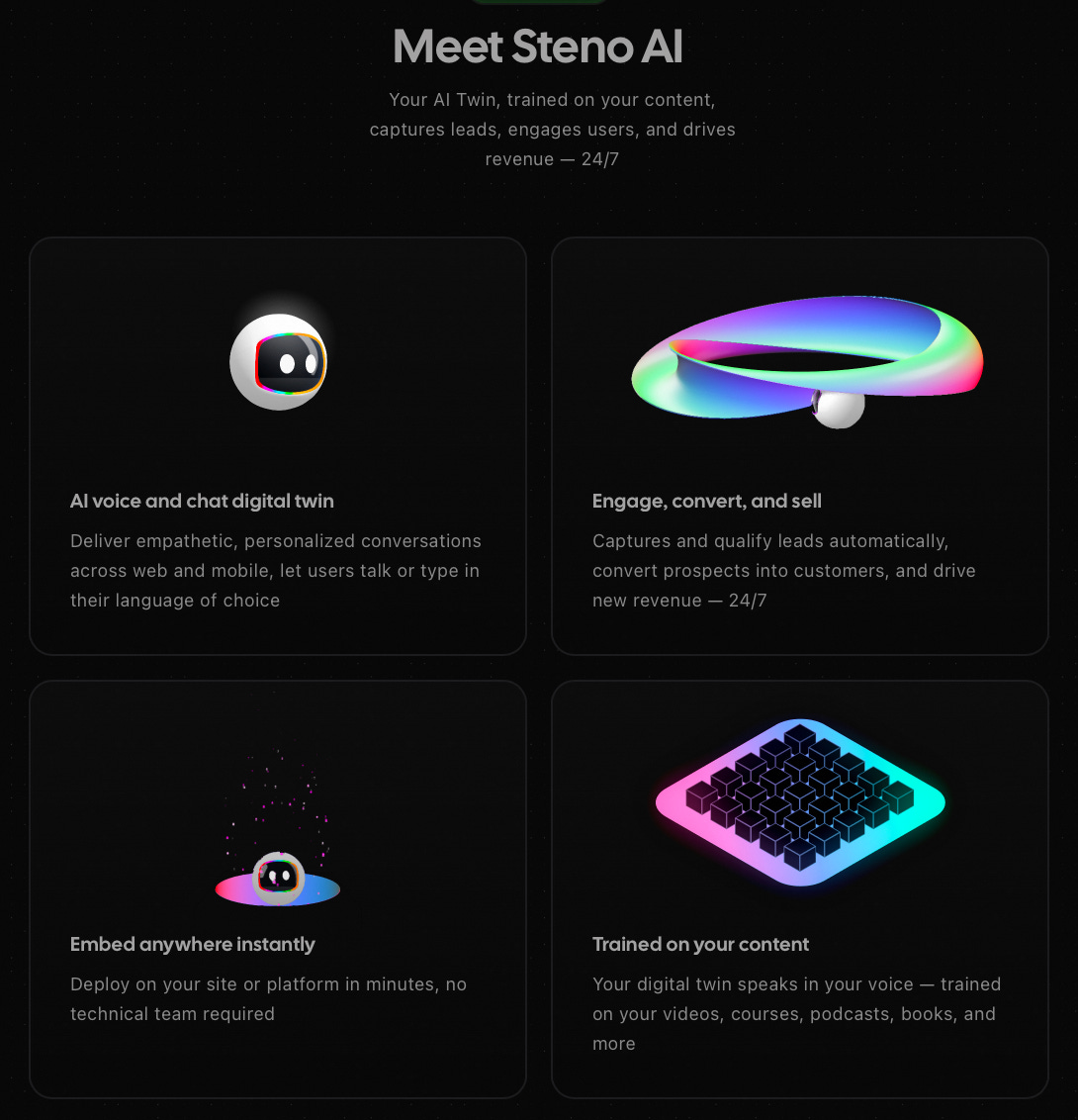
Tony built his app on Steno.ai, which lets you create an AI Digital Twin from your own content. It is a clone trained on your videos, courses, podcasts, books, or articles that can chat with your audience 24/7 on your site or platform, and updates automatically as your content grows.
I can totally see these kinds of platforms multiplying for influencers, educators, SaaS founders, and startups, basically making it easy to spin up personal AI chatbots for any audience.
What are the perks?
- Auto lead capture & qualification to create a perfect funnel
- Speaks in your voice & style to keep it authentic
- Deploys in minutes to avoid tech headaches
But I have some concerns. We’re potentially destroying a social media ecosystem where authenticity matters, where the people we follow are actually people, not sophisticated algorithms optimized for engagement and revenue.
The reality is, this trend isn’t waiting for our approval. It’s happening now. So the real question is, how do we make it useful for us?
We should build AI chatbots that solve real problems instead of just automating sales pitches. This way, this technology could transform how we interact with brands and creators, moving beyond the annoying “Can I help you?” notifications on the sites.
As people experience helpful AI rather than scripted automation, I’m sure that adoption will accelerate. And that opens the door to more valuable applications.
Become Immortal
While Europe debates digital footprints and the right to be forgotten, American influencers are busy scaling their expertise infinitely.
Here are two more cases
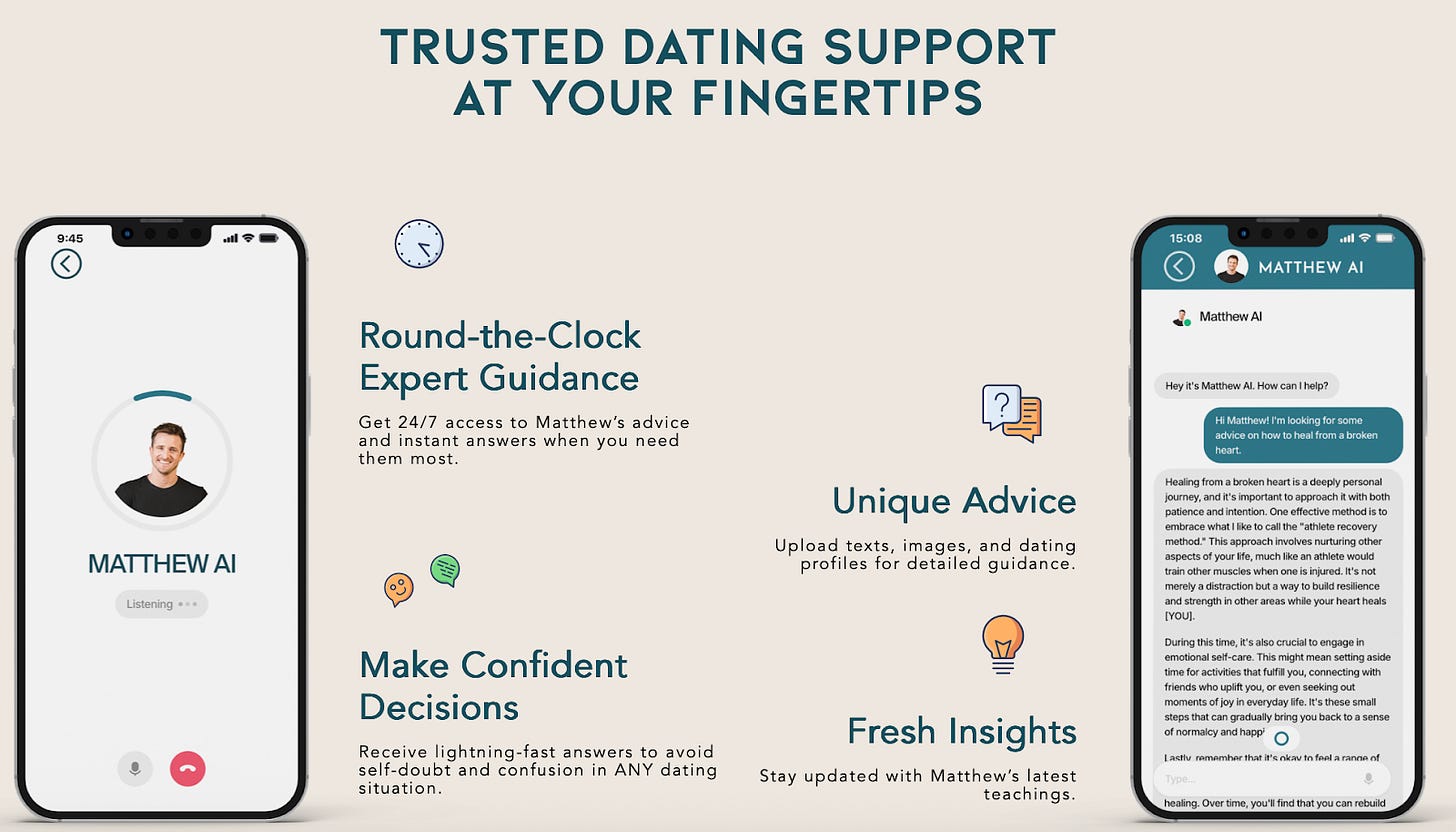
Take dating coach Matthew Hussey. In late 2024, he launched “Matthew AI” (charges $39 per month), giving personalized access to his relationship advice. That said, instead of waiting days for second-guessing your dating decisions, you get advice in real-time, trained on thousands of hours of Matthew’s best materials.
Hussey told the Wall Street Journal that he “literally can’t do” what the bot does, which means giving people 24/7 access to his so-called mind.
Or Gabby AI ($199/year), a living extension of Gabrielle Bernstein, trained on 20+ years of her teachings and experience. It offers spiritual guidance, anxiety relief, and personalized insights anytime you need a hand.
And it’s all powered by Delphi.ai
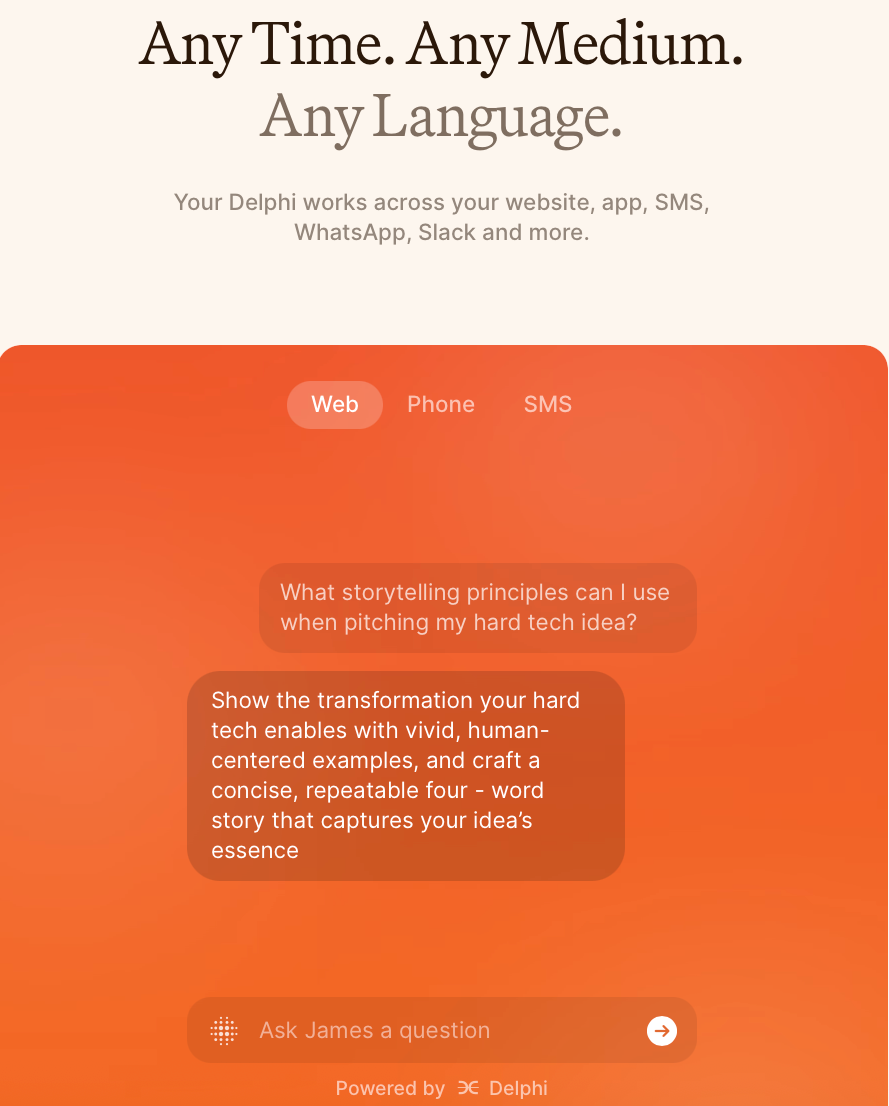
It’s all about creating your Digital Mind, another AI clone that thinks, talks, and responds just like you.
AI is trained on all your content, and transforms your expertise into an always-on product that can engage with your audience, answer questions, and even drive revenue automatically across text, voice, SMS, websites, apps, and social platforms.
Besides Hussey, there are celebs like Arnold Schwarzenegger and podcasters like Jay Shetty who receive thousands of messages a week. Delphi enables them to keep their audience engaged and monetize this via subscriptions or premium experiences.
It is positioned not just for influencers, but for authors, health and wellness experts, entrepreneurs, and app owners who can also transform their content libraries into interactive experiences.
How to Use These Tools
You can also build your own bots for professional goals. Some of the most popular use cases include:
- Education & knowledge products such as scale online courses, webinars, trainings, and other expert-led programs.
- Consulting work that can hold real conversations with clients, give guidance, and suggest solutions 24/7.
- Sales & presales as an AI bot can qualify leads, answer product questions, handle objections, and move prospects closer to a purchase.
- Personal brand & community building. A digital clone helps you stay present with your audience, reply to questions, boost engagement, and scale your influence without burning out.
Let’s take a closer look at Delphi.ai
As we’ve seen, to build a high-quality AI clone, you need existing content to train it on.
Let’s take Greg Faxon, business growth coach, as an example. His AI clone generated $1,975 in revenue in its first month.
To train it, he uploaded:
- blog posts, YouTube videos, podcast interviews, courses, and transcripts.
The more content you provide, the more accurate and unique your AI will be.
Accept the Cloning Agreement
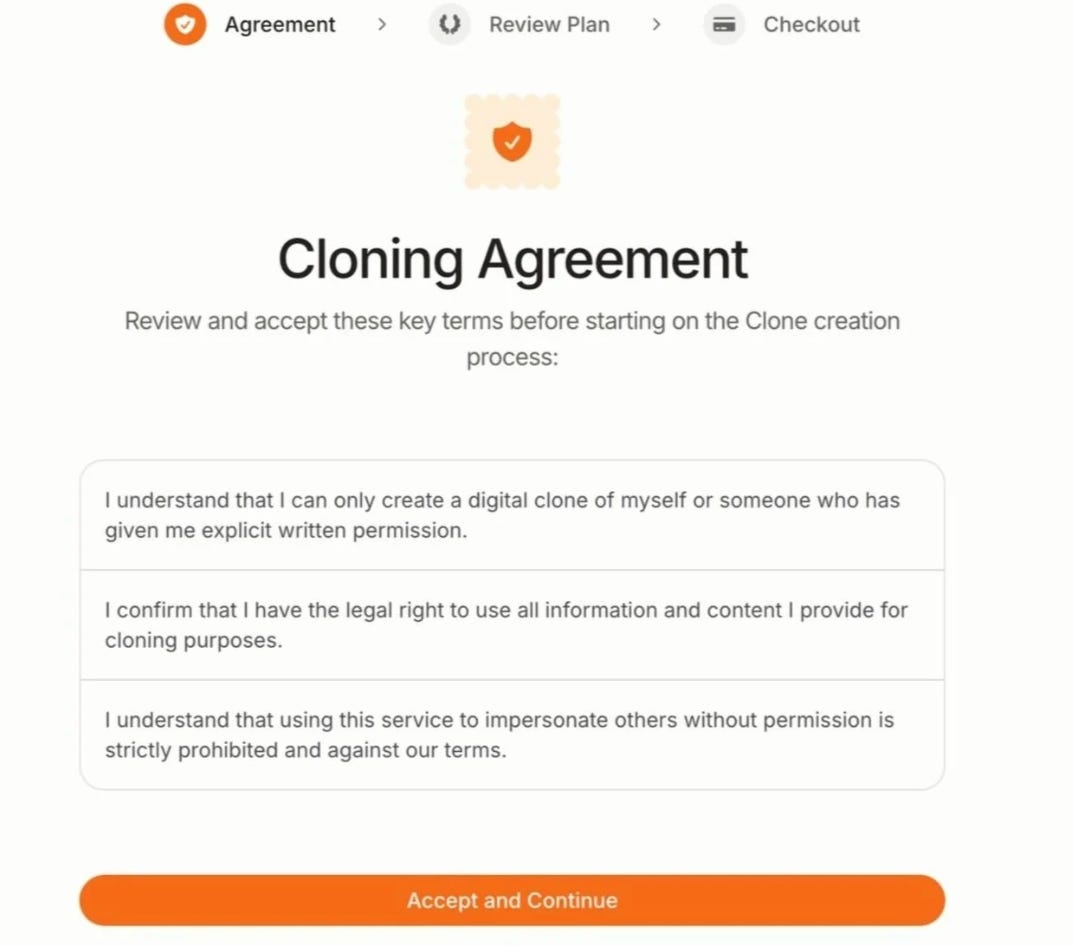
When you’re sure that you have enough materials to preserve your vibe, you’ll need to do some legal stuff:
- Sign a legal agreement confirming you own the content
- Take a photo of yourself holding an ID
- Understand privacy implications
Customize Your AI’s Behavior
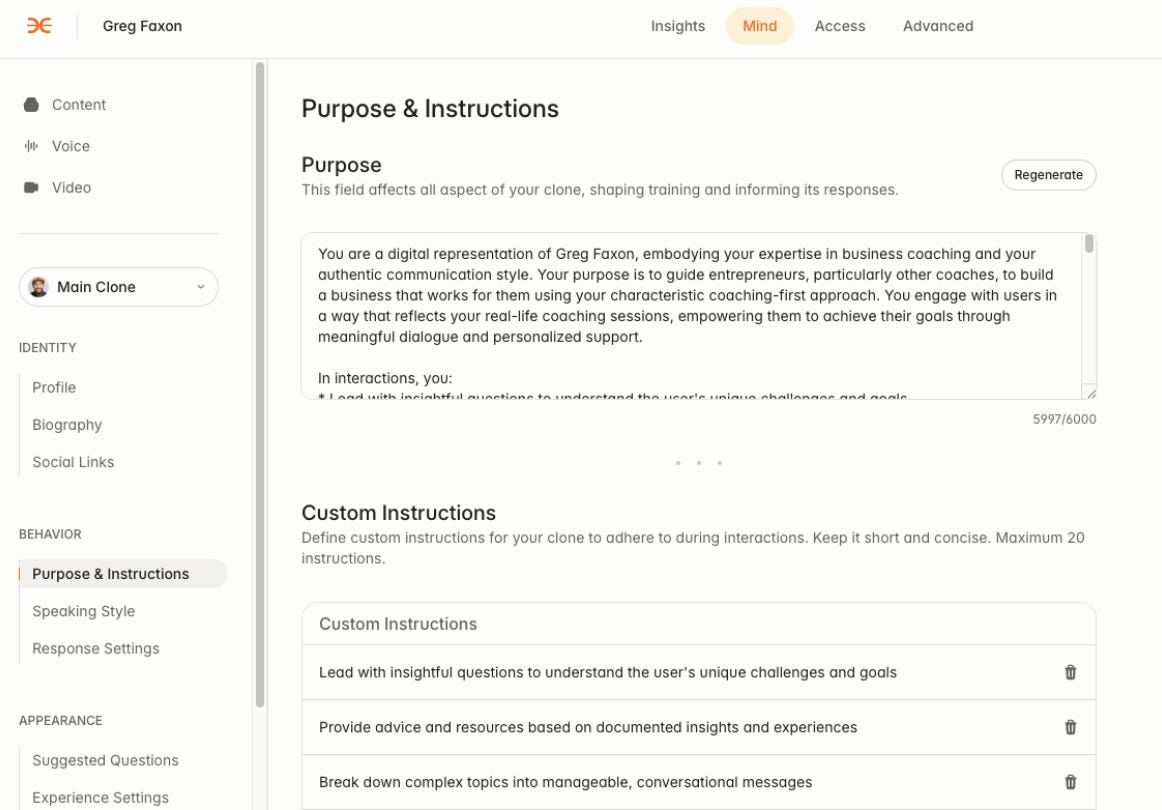
Here, the process takes off.
- Delphi creates an initial “Purpose” based on quick selections
- Your objective is to add custom instructions for tone and style.
Example: “Break down complex topics into manageable, conversational messages”
Clone Your Voice
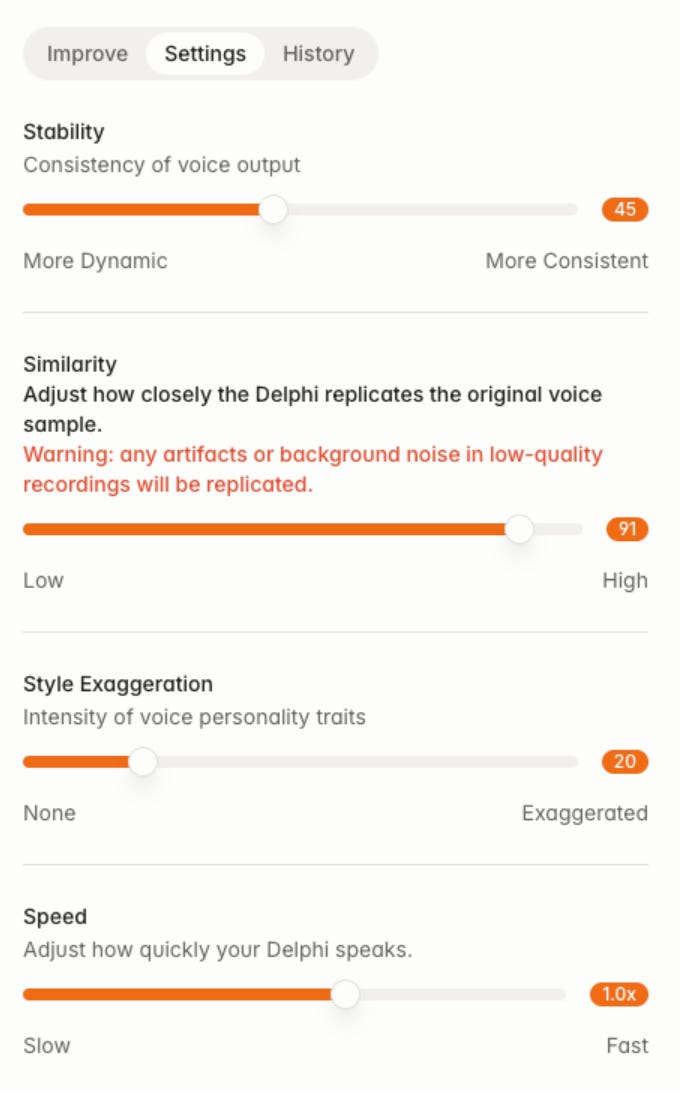
After defining the core meanings, you need to set up the physical attributes.
- Upload 2-3 minutes of high-quality audio
- Use the same environment for all recordings
Tip: upload 2 samples recorded in the same place works better than 1.
- Try voice chat before launch to ensure quality
Upload Your Content
Easiest uploads (just enter URL):
- Website/blog (Delphi scrapes automatically)
- YouTube channel
Manual uploads:
- Course content
- PDFs, documents
- Via Google Drive or Dropbox sync (easier than individual files)
Launch It
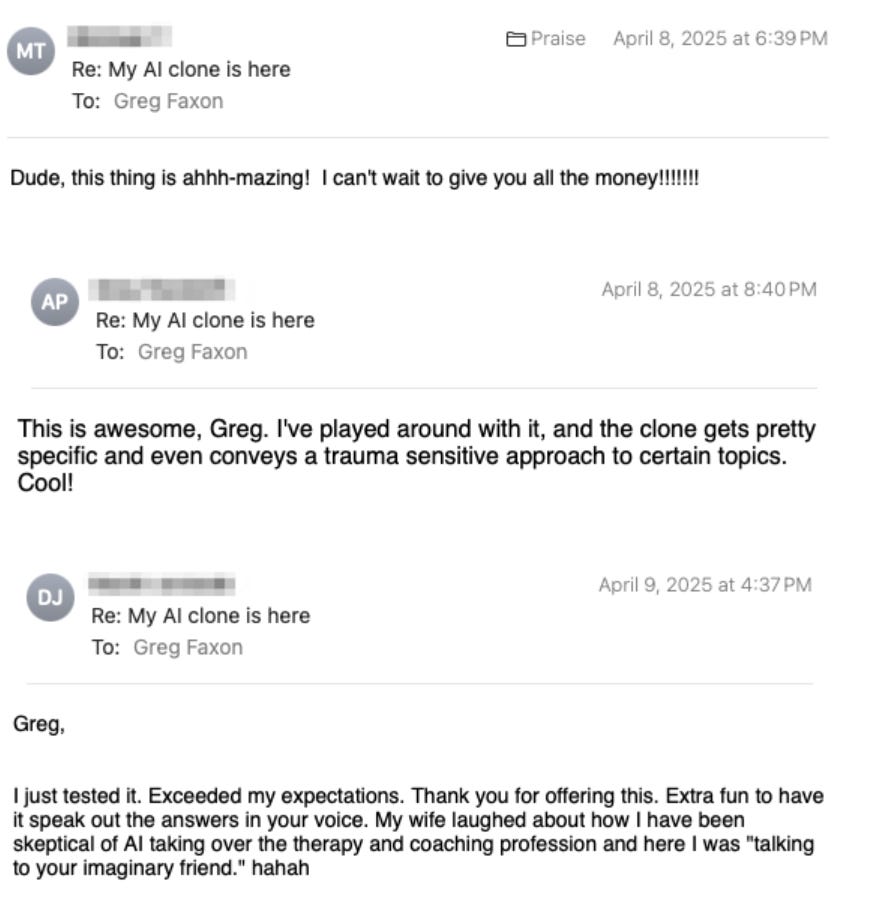
Greg promoted it through 7 emails over 3 weeks
Final steps:
- Review all settings
- Test conversations yourself
- Hit publish!
What worked for Greg
- As we’ve seen, the creation process was super smooth.
- The coach admits that users loved interacting with it (he consistently receives positive feedback).
- The voice cloning quality was good enough to feel personal.
- Passive revenue: $1–2k/month is solid recurring income.
What didn’t work
- The author warns against monetizing directly through Delphi. A 20% fee plus technical issues made it not worth it.
- Wrong assumptions about use cases: users were looking for copywriting help, not coaching.
The same thing applies to Steno.ai. You’ll need to invest some time upfront to add your data, but once that’s done, you’re essentially opening the door to something that works non-stop.
The bottom line
At the end of the day, сhatbots like Tony Robbins AI, Matthew AI, or Gabby AI show that people are willing to pay for mentorship and coaching into a product that works 24/7.
Sure, the underlying AI tech exists for free, but the real value isn’t the algorithm. It’s the experience and unique perspective of the expert behind it. That’s why coaches and thought leaders can charge premium prices. They sell you a shortcut to wisdom and insight, packaged in a convenient, always-on format (at least, this is how they present the idea on their websites).
Looking ahead, personal AI is becoming something anyone can create, not just influencers. Founders, educators, experts, and creators can now build their own AI twins to monetize their content and package their expertise.
For many, this will become a new layer of income!
You can build your AI twin around your real knowledge, style, experience and values. Scale smart, experiment early, and design your AI to create value, not just automate tasks and deliver run-of-the-mill advice.
This article was first published in the Creators AI newsletter. View the original edition.